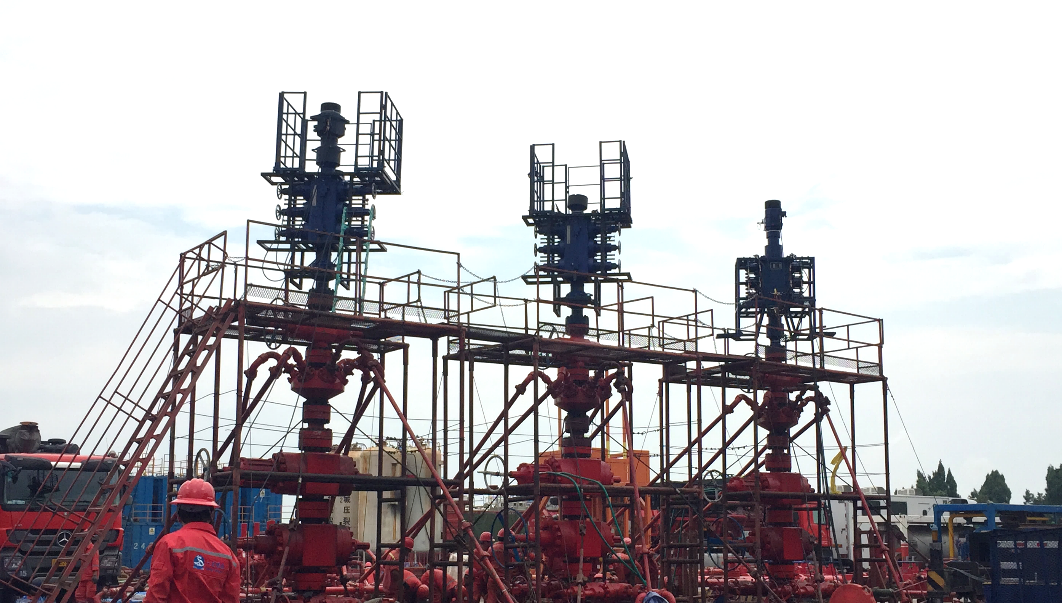
The loss of mud into your formation may also lessen the mud degree in the wellbore, that may reduced the hydrostatic pressure in the opening. In shale sections, this induced lesser wall support may perhaps result in sloughing of shales, which further more may possibly cause pipe sticking. To paraphrase, It could cause wellbore instability problems.
Aligned with properly's everyday living cycle Specific knowledge of reservoir and root reason for fluid loss delivers control that aligns with well’s life cycle
Figure 6b demonstrates that, through circulation, drilling fluid flows downward In the drill pipe. Owing to your somewhat clean internal wall with the drill pipe, frictional force losses are small. Additionally, gravitational possible Vitality converts to kinetic Strength for the duration of downward movement, causing a progressive boost in fluid velocity along the drill pipe. At the little bit nozzle exit, circulation constriction induces considerable frictional pressure losses, additional accelerating fluid velocity close to the wellbore bottom. Conversely, as fluid exits the drill pipe and enters the annulus for upward flow, velocity slowly decreases on account of superior wall roughness and the conversion of kinetic Electrical power back to gravitational opportunity Electricity. The upward velocity is considerably reduce compared to the downward velocity throughout the drill pipe. Discipline observations indicate that an entire drilling fluid cycle comprises downward and upward phases, Together with the upward phase period noticeably exceeding the downward period. The velocity distribution in Determine 6b explains this phenomenon. Previous to loss initiation, no fluid flows within closed fractures; So, velocity stays zero throughout.
would be the radial distribution purpose of good stage, dimensionless. In the event the solid concentration increases, g 0
The drilling fluid loss problem in purely natural fractured formations was studied employing a two-period model that integrated drilling construction parameters, drilling fluid rheological Attributes, and fracture geometry parameters.
Research and innovation will have to normally keep on being a focus. Scientific research and technological enhancements are escalating to prevent fluid loss. Synthetic intelligence and knowledge Examination are Among the many variables that continue on to take care of their significance. AI systems and big facts analysis are utilized to forecast prospective fluid loss dangers inside the drilling procedure in advance. New chemical substances and additives are critical in establishing more practical and eco-friendly anti-leak actions.
It is the mud lost in the development when well drilling because of high permeability, fracture or higher mud bodyweight. We are more worried about these losses, based on severity down hole losses can be classified as.
Fat proportion of primary control variables of differing types of your drilling fluid lost control effectiveness.
To validate the dependability of numerical simulations, this examine utilized a multiphase circulation migration experimental apparatus that has a coupled wellbore–fracture procedure for lost circulation testing. The apparatus contains a wellbore diameter of one hundred fifty mm and a duration of one.five read review m, comprising three built-in modules: wellbore–fracture coupling module, mud preparing–pumping integration module, and unified control–information-acquisition module.
, 2024; Nabavi et al., 2025). By integrating device learning into the prediction of mud loss, it results in being possible to produce adaptive products that reply dynamically to the numerous variables that affect drilling functions. This paradigm change represents a big possibility to advance comprehension of mud loss phenomena and increase drilling operations�?basic safety and efficiency.
Identify the reduction in hydrostatic head and decrease the active technique to this calculated equal mud bodyweight. Checking the hole quite carefully for doable well control troubles is a necessity.
Determine 10c exhibits that, Even though the depths from the thief zone are different, beneath the exact same fracture geometric problems, the fluid pressure from the fracture is identical in the course of the steady loss phase, And so the greater the BHP similar to the stable loss stage, the larger the overbalanced pressure. This explains why the loss rate of drilling fluid improves with the rise in the thief zone depth through the secure loss stage. The loss of drilling fluid will bring on a decrease in standpipe strain, and the dimensions of the decrease in standpipe tension reflects the severity of drilling fluid loss. The loss amount of drilling fluid raises with the rise in properly depth, and also the corresponding minimize in standpipe stress will likely maximize with the rise in well depth. The exploration success of drilling fluid loss conduct at diverse thief zone depths also reveal why, while in the drilling means of deep limited oil and fuel reservoirs, substantial loss and severity loss often happen within the lessen formations, and the increase in perfectly depth will make a larger overbalanced force.
Body weight proportion of main control factors of differing kinds with the drilling fluid lost control effectiveness.
. The performance of those additives can be quantified utilizing the permeability reduction element (Rk) and that is calculated as: